


An E-2 visa through citizenship by investment (CBI) allows nationals of countries that are not party to the E-2 Treaty Countries to become eligible for an E-2 investor visa by first acquiring the citizenship of a qualifying treaty country. Harvey Law Group advises clients on both the CBI process and the subsequent US E-2 visa application.
The E-2 visa is a renewable non-immigrant visa that allows qualifying investors to live in the United States while developing and directing their business. It does not offer a direct route to permanent residence or US citizenship. Applicants should also be aware that, depending on the treaty country applied through, additional conditions, including domicile requirements under the relevant treaty, may apply before an E-2 visa application can be submitted.
Harvey Law Group currently advises on three investment citizenship programmes that can establish E-2 eligibility: Grenada, Turkey and Egypt. Each of these countries is an E-2 treaty signatory with the United States. Grenada citizenship for an E-2 visa remains the most established and accessible option, as Grenada is the only Caribbean investment migration programme with a US E-2 treaty relationship.
Obtaining an E-2 visa through second citizenship is an attractive option for entrepreneurs and investors from countries that are not included on the US E-2 visa countries list, including China, India, Vietnam, Brazil, Russia, the United Arab Emirates, Saudi Arabia and Nigeria, who wish to establish or acquire a qualifying business in the United States.
Processing times vary by programme. Grenada citizenship typically takes around four to six months, while Turkish citizenship generally takes three to six months and Egypt citizenship through investment takes six to twelve months. Once citizenship has been granted, applicants may proceed with the US E-2 visa application, provided they satisfy the applicable US E-2 visa requirements, including nationality, investment and business operation requirements.
Why does the E-2 visa require a second citizenship for some investors?
The US E-2 visa is available only to nationals of E-2 treaty countries, meaning states that maintain a qualifying commerce and navigation treaty with the United States. If your country of citizenship is not an E-2 treaty signatory country, you cannot qualify for an E-2 visa solely because you intend to invest in the United States or meet the financial requirements. Treaty nationality is a mandatory eligibility requirement and must be in place before an E-2 application can be approved.
For many international investors, acquiring citizenship in a qualifying treaty country is therefore the first step towards becoming eligible for the E-2 visa. Second citizenship has become the most established route because it allows applicants to obtain a second nationality through a government-approved investment programme before pursuing the E-2 application.
The E-2 visa offers a number of practical advantages for international entrepreneurs seeking to establish a business presence in the United States. It allows the main applicant to establish, acquire or expand a qualifying US enterprise and to live in the country while actively directing and developing that business.
E-2 status may be renewed for as long as the underlying business continues to satisfy the treaty eligibility requirements. An accompanying spouse may also apply for work authorization in the United States. Unlike several other US visa categories, the E-2 visa is not subject to an annual numerical quota.
The Caribbean CBI route is particularly attractive for nationals of countries that do not currently have an E-2 treaty with the United States, including: China, India, Vietnam, Brazil, Russia, United Arab Emirates, Saudi Arabia, Nigeria and South Africa.
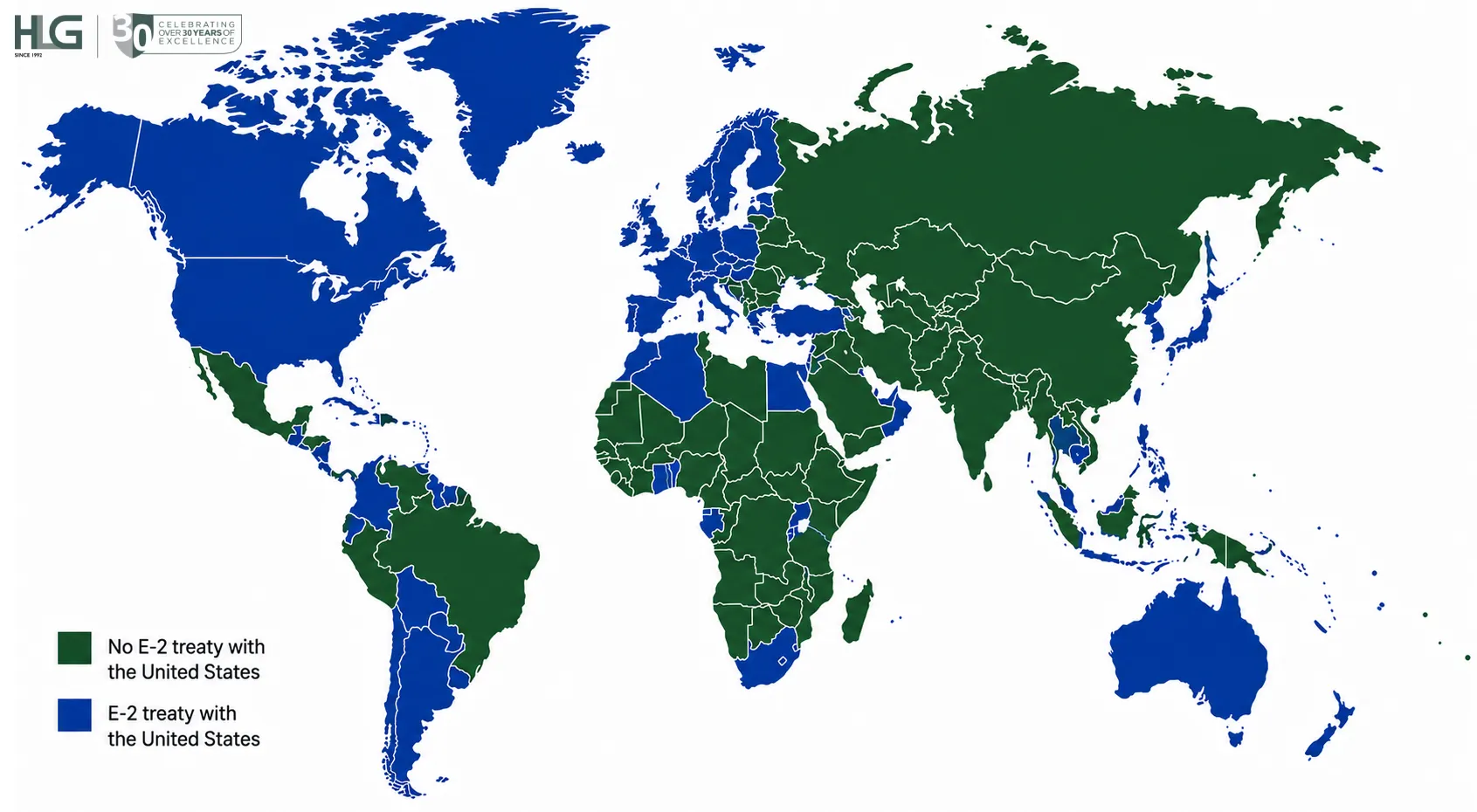 E-2-treaty countries map
If an applicant has lawfully acquired citizenship of an eligible treaty country before applying, they may become eligible to pursue the E-2 visa, provided all other US immigration requirements are satisfied.
Which E-2 treaty countries offer citizenship by investment?
Harvey Law Group currently advises on three economic citizenship programmes that offer eligibility for the US E-2 visa: Grenada, Turkey and Egypt.
Although each programme grants citizenship through its own legal framework, with different investment thresholds, eligibility criteria and processing timelines, all three are based on countries that maintain an E-2 treaty relationship with the United States. Once citizenship has been granted, applicants may proceed with an E-2 visa application, provided they satisfy the eligibility requirements.
It is also important to understand which investment migration programmes do not offer E-2 eligibility. Several Caribbean programmes, including Dominica, Antigua and Barbuda, Saint Lucia, and St Kitts and Nevis, remain well-established and very popular options for High-net-worth individuals. However, none of these programmes offer access to the US E-2 visa.
For investors whose main objective is to establish or acquire a business in the United States through the E-2 visa, selecting the appropriate investment-based citizenship programme is the first and arguably the most important step. Choosing a programme that does not confer E-2 eligibility will prevent an application, regardless of the level of investment or the commercial merits of the proposed US business.
How does the Grenada citizenship route to the E-2 work?
Grenada offers one of the most established CBI programmes in the Caribbean. Investment citizenship applications are typically processed within approximately four to six months.
The Grenada investment citizenship programme offers two principal investment routes, through either a qualifying government contribution or an approved real estate investment. The current investment thresholds are available on Harvey Law Group's dedicated Grenada programme pages.
Applicants who choose to invest via the approved real estate route should note that the qualifying investment is subject to a five-year holding period before disposal.
Once citizenship has been granted, Grenadian nationals may become eligible to apply for the US E-2 visa.
Grenada remains the only Caribbean economic citizenship programme that provides eligibility for the E-2 visa.
As well as E-2 eligibility, Grenada is known for its wide family inclusion policy. Depending on the circumstances, an application may include:
- A spouse
- Children under 30
- Parents
- Grandparents
- Certain unmarried, childless siblings over 18
Grenada does not require applicants to relocate permanently, meet language proficiency requirements or attend an interview before citizenship is granted. Applicants should, however, be aware of the proposed requirement to spend at least 30 days in Grenada during the first five years after obtaining citizenship.
For many entrepreneurs from China, India and other non-treaty countries, Grenada represents the most direct citizenship by investment route to future E-2 eligibility because it combines relatively efficient processing with one of the widest family definitions available under any Caribbean programme.
How does the Turkey citizenship route to the E-2 work?
Turkey also offers a well-established investment migration programme with E-2 visa eligibility. Turkish CBI is focused mainly around the applicant making a qualifying real estate investment. Citizenship is generally granted within approximately three to six months, after which Turkish citizens may become eligible to pursue the US E-2 visa.
The principal route involves purchasing qualifying Turkish real estate and maintaining ownership for the required holding period of at least three years.
Applicants should also be aware of several administrative requirements that are specific to the Turkish programme, including obtaining an approved valuation report and complying with the mandatory Currency Purchase Certificate process.
Unlike many residence-by-investment programmes, Turkish citizenship does not require applicants to establish ongoing physical residence, demonstrate Turkish language ability or meet educational criteria before naturalisation.
However, one drawback is that family eligibility is more limited than Grenada. Applications may generally only include:
- A spouse
- Dependent children under 18
As a G20 economy positioned between Europe and Asia, Turkey appeals to entrepreneurs with existing commercial interests across multiple regions. Some investors also prefer holding a tangible real estate asset rather than making a government contribution, particularly where property ownership forms part of a wider international investment strategy.
For applicants whose objectives extend beyond the US E-2 visa, Turkey can therefore offer both business diversification and access to a second citizenship within a comparatively short timeframe.
How does the Egypt citizenship route to the E-2 work?
Egypt established its Programme under Law No. 190 of 2019, creating a legal pathway for qualifying foreign investors to acquire Egyptian citizenship. Processing generally takes between six and twelve months. Following naturalisation, applicants may proceed with a US E-2 visa application, subject to the relevant treaty provisions and the US eligibility requirements.
Unlike Grenada and Turkey, Egypt offers four separate investment pathways, allowing applicants to choose the structure that best suits their financial objectives and long-term planning.
The available routes include:
- A qualifying government contribution.
- An approved real estate investment.
- A qualifying business investment combined with the required government contribution.
- A refundable bank deposit that is returned after the prescribed holding period in accordance with Egyptian law.
One of the distinguishing features of the Egyptian CBI Programme is the refundable bank deposit option. Unlike a non-refundable government contribution, this route requires applicants to place a qualifying deposit with an Egyptian bank, with the principal repayable after three years in Egyptian pounds, subject to the applicable legal and programme requirements.
Eligible family members generally include:
- A spouse
- Dependent children
Compared with the Caribbean programmes, Egyptian citizenship provides more limited visa-free travel. For many investors, however, international mobility is not the principal consideration. Instead, the programme is selected for its strategic value, creating a potential pathway to the US E-2 treaty investor visa while providing citizenship of one of the Middle East and North Africa region's largest economies. Applicants should also note that the application process requires at least one visit to Egypt.
For applicants focused primarily on establishing a business presence in the United States, Egypt represents a strategic alternative that differs significantly from both the Caribbean and Turkish programmes.
What is the three-year domicile requirement for CBI applicants?
One of the most common questions raised by prospective applicants is whether individuals who acquire citizenship through an investment-based citizenship programme must satisfy a three-year domicile requirement before becoming eligible for a US E-2 visa.
The issue arises from amendments to US immigration law introduced in December 2022. Although the legislation established a new statutory framework, the recent Trump Administration Executive Order does not affect the E-2 treaty investor visa, as it applies only to B-1/B-2 visitor visas.
Which programme is best for E-2 access? (comparison table)
There is no universally "best" programme. The most suitable solution depends on the applicant's objectives, family circumstances, preferred investment structure and wider international planning considerations.
For investors whose main objective is obtaining access to the US E-2 visa, Grenada is often the most popular option. It remains the only Caribbean programme that provides a treaty basis for E-2 eligibility, while also allowing the applicant to include a wide range of qualifying family members as dependents.
Only a small number of investment migration programmes are based in E-2 treaty countries. Grenada, Turkey and Egypt are the three currently advised on by Harvey Law Group.
| Factor | Grenada | Turkey | Egypt |
|---|---|---|---|
| Treaty basis for E-2 | US E-2 treaty | US E-2 treaty | US E-2 treaty |
| Citizenship processing | Approx. 4 to 6 months | Approx. 3 to 6 months | Approx. 6 to 12 months |
| Investment nature | Donation or real estate | Real estate (recoverable after hold) | Four routes incl. refundable deposit |
| Holding period | 5 years (real estate) | 3 years | 3 years (deposit route) |
| Residency requirement | None | None | None ongoing; one visit required |
| Family inclusion | Spouse, children under 30, parents, grandparents, siblings (conditions) | Spouse, children under 18 | Spouse, dependent children |
| Language test | None | None | None |
| Programme established | Long-running Caribbean CBI | 2017-era programme | 2019 (Law No. 190) |
What must you still prove for the E-2 after obtaining citizenship?
Obtaining citizenship of an eligible treaty country creates the opportunity to apply for the E-2 visa. It does not guarantee approval. Every applicant must still satisfy the eligibility requirements of the E-2 visa program.
Most importantly, acquiring citizenship of an E-2 treaty country does not remove the need to satisfy the substantive requirements of the E-2 visa itself. Under US immigration law, the applicant must make a substantial investment in a genuine US enterprise, and that investment must be at risk in the commercial sense. This means the invested capital must be committed to the business and exposed to partial or total loss if the enterprise is unsuccessful. Simply obtaining citizenship of an eligible treaty country does not reduce these requirements. The business cannot exist solely to support a visa application. It must represent a legitimate commercial enterprise that contributes to the US economy and creates jobs for qualified US workers.
Applicants should also expect to demonstrate that:
- The investment is substantial in relation to the business and genuinely at risk, meaning the capital has been irrevocably committed to the enterprise and is exposed to partial or total loss if the business fails.
- The business is active rather than passive.
- They will develop and direct the enterprise on a day-to-day basis.
- The investment funds were obtained from lawful sources.
- Appropriate due diligence requirements have been satisfied.
- They meet the applicable health and character requirements.
These requirements are significant because the E-2 visa already requires applicants to commit substantial capital to a genuine commercial enterprise. Although economic citizenship establishes treaty nationality where an applicant's original citizenship does not qualify, applicants must still independently satisfy the US investment requirements. In practice, this means the citizenship investment and the US business investment serve different legal purposes and are assessed separately.
The E-2 visa is intended for entrepreneurs who will actively operate and be involved in their business. Simply purchasing property, holding shares in a company or making a passive investment will not normally satisfy the programme's requirements. Examples of some activities that may be eligible for the E-2 visa include:
- Franchises
- Technology companies
- Consulting businesses
- Hospitality operations
- Import-export businesses
- Professional service firms
What is the step-by-step process and timeline?
Although every application differs, the process will generally follow the same sequence.
Step 1. Initial assessment
The applicant's nationality, business objectives, family circumstances and investment preferences are reviewed to determine which citizenship programme is the most suitable.
Step 2. Due diligence and document preparation
Supporting documentation is prepared, including identity documents, financial records and evidence demonstrating the lawful source of investment funds.
Step 3. Citizenship application
The application is submitted through the selected programme and undergoes government due diligence before approval.
Step 4. Citizenship approval
Following approval, citizenship is granted and the applicant receives a passport from the relevant jurisdiction.
Step 5. US business preparation
Attention then turns to the United States. This typically involves selecting or establishing a qualifying business, preparing the investment structure and developing a comprehensive business plan.
Step 6. E-2 visa application
Once all requirements have been satisfied, the applicant may submit the E-2 visa application through the appropriate US consulate.
What are the risks and limitations of this route?
Although those programmes may allow the applicant to be eligible for the US E-2 visa, it is important to understand the legal and practical limitations before selecting a programme.
The E-2 visa is a non-immigrant classification. While it may be renewed indefinitely, provided the eligibility requirements continue to be satisfied, it does not provide a direct pathway to US permanent residence or citizenship.
Acquiring the citizenship of an E-2 treaty country is only one part of the application. Every case is assessed on its own facts, and applicants must also satisfy the applicable investment, business and evidential requirements under US immigration law.
CBI programmes are also subject to legislative and policy change. Investment thresholds, eligibility criteria and processing procedures may be amended, while international treaty relationships and immigration policy can evolve over time.
The choice of programme should be considered carefully. Family eligibility rules differ significantly, as do the available investment options. Some programmes are centred on government contributions, others on qualifying real estate investments, while Egypt also offers a refundable bank deposit route.
It is highly recommended that applicants should obtain legal advice before committing to any investment. The most appropriate solution depends not only on obtaining a second citizenship, but on selecting the route that best supports the applicant's wider immigration, business and international planning objectives.
How does Harvey Law Group assist?
Choosing the right investment-based citizenship programme is only one part of the process. Applicants must also consider family eligibility, investment structure, due diligence requirements and how the chosen programme aligns with their longer-term requirements.
Since 1992, Harvey Law Group has advised investors, entrepreneurs and families on investment migration solutions across multiple jurisdictions. The firm's international team assists clients with the second citizenship programmes offered by Grenada, Turkey and Egypt, providing guidance throughout the application process and coordinating with trusted professionals where required.
Once citizenship has been granted, eligible applicants may proceed with a US E-2 visa application, subject to the applicable requirements of US immigration law. Harvey Law Group advises clients throughout this process, from selecting the most appropriate second citizenship programme to assessing E-2 eligibility and ensuring the chosen strategy aligns with their broader business, investment and international mobility objectives.
Learn more about the firm's Grenada, Turkey and Egypt Citizenship programmes, and US E-2 Visa services.
Frequently asked questions
Can Chinese citizens get a US E-2 visa?
Chinese citizens cannot normally apply for a US E-2 visa using Chinese nationality because China is not an E-2 treaty country. However, obtaining citizenship of an eligible treaty country, such as Grenada, Turkey or Egypt, may create E-2 eligibility, provided all US immigration requirements are subsequently met.
Can Indian citizens apply for the E-2 visa?
Indian nationals face the same issues as Chinese citizens. India is not an E-2 treaty country, meaning Indian citizenship alone does not qualify for the visa. Some investors first obtain citizenship through an eligible investment programme before pursuing the E-2 route.
Which Caribbean citizenship programme provides E-2 eligibility?
Grenada is currently the only Caribbean second citizenship programme that provides access to the US E-2 visa. Other Caribbean programmes, including Dominica, Antigua and Barbuda, Saint Lucia, and St Kitts and Nevis, do not create E-2 eligibility.
Does Turkey have an E-2 treaty with the United States?
Yes. Turkish nationals may apply for the US E-2 visa provided they satisfy the immigration requirements governing the programme, including making a qualifying investment into a genuine US business.
How long does the E-2 Visa entire process usually take?
The overall timeline depends on the citizenship programme selected, document preparation, government processing and the subsequent US consular application. Citizenship itself is commonly completed within four to twelve months depending on the jurisdiction, after which the E-2 application can proceed.
How much do I need to invest in the United States?
There is no single statutory minimum investment for the E-2 visa. The investment must instead be substantial in relation to the business being established or acquired and must be genuinely committed and at risk.
Can my spouse work in the United States?
Yes. The spouse of an approved E-2 visa holder may generally obtain work authorization, allowing employment in the United States while the principal applicant manages the qualifying business.
Does the E-2 visa lead to a Green Card?
No. The E-2 is a renewable non-immigrant visa. Although other US immigration pathways may become available in the future, the E-2 itself does not automatically lead to permanent residence.
Do I need to live in Grenada, Turkey or Egypt before applying?
Applicants should seek legal advice regarding any residence or domicile requirements that may apply to their individual circumstances before proceeding with an E-2 strategy. This area continues to receive significant legal attention and should be assessed on a case-by-case basis.
Can I include my parents in the citizenship application?
It depends on the programme. Grenada offers one of the broadest family eligibility frameworks and may allow parents, grandparents and certain siblings to be included. Turkey and Egypt have considerably narrower definitions that generally focus on spouses and dependent children.
Request a Consultation
Confidential legal advice on citizenship, residency, and business law matters worldwide.
Contact Us